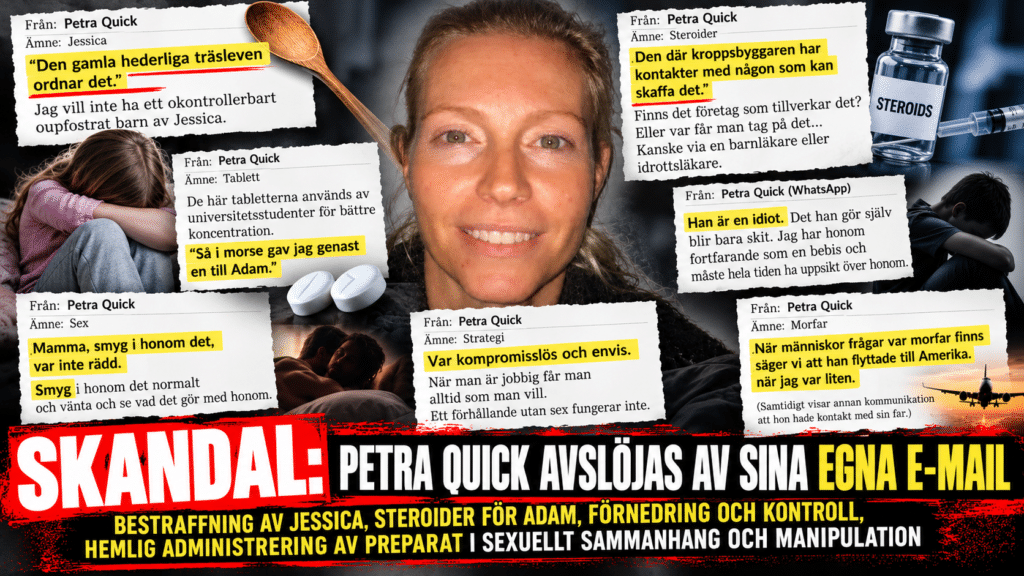

etra Quick Is Exposed by Her Own Words
This is not about anonymous accusations. It is not about a witness trying to remember events years later. And it is not simply one person’s word against another.
At the center of the material are Petra Quick’s own private emails and WhatsApp messages.
And their content raises serious questions.
In her own communications, Petra writes about punishing the young Jessica, authority and discipline. She discusses Adam Quick’s growth and steroid preparations, states that she gave Adam an unidentified tablet, uses degrading language about him, and encourages another person to give a man a substance without his knowledge in a sexual context.
These are not statements someone else has put into her mouth.
They are her own words.
Jessica: Punishment of a Child and “The Good Old Wooden Spoon”
In communications concerning the young Jessica, Petra Quick discusses authority, obedience and punishment.
She writes that Jessica should be punished.
Then comes her own phrase:
“Stará dobrá vařečka to spraví.”
A natural English translation is:
“The good old wooden spoon will sort it out.”
She then writes that she does not want Jessica to become an “uncontrollable, badly behaved child.”
The context matters. Petra is not discussing a wooden spoon in connection with cooking. The remark comes directly after discussion of lack of authority, the child’s behavior, punishment and regaining control.
The email does not by itself prove exactly whether, when or how often Jessica was physically struck.
But it does establish something that cannot simply be ignored:
Petra herself referred to a wooden spoon as a solution in the context of disciplining a young child.
Not Only Punishment – Petra Demands Authority and Obedience
In the same communication, Petra criticizes what she considers excessive permissiveness toward Jessica.
She talks about authority and about the need to set firm limits.
Petra presents herself as the person who:
- sets rules,
- demands obedience,
- criticizes another person’s parenting,
- gives instructions on how Jessica should be treated,
- and supports disciplinary consequences.
That is difficult to reconcile with the image of someone who lacked decision-making power or control within the family.
Adam: Petra Herself Discusses Steroid Preparations
Another part of the communication concerns Adam Quick’s height and physical development.
Petra discusses his growth and puberty and writes that she feels he is growing very little.
The conversation then turns to steroid preparations.
Petra herself discusses where such substances might be obtained.
Among the statements appearing in the communication are:
“That bodybuilder has contacts with someone who can get it.”
She also asks:
“Are there companies that manufacture it? Or where do you get it from…”
and discusses the possibility of obtaining it through a pediatrician or sports doctor.
The material therefore does not show Petra as someone who was outside the steroid issue.
It shows her as an active participant in discussions about obtaining steroid preparations and influencing Adam’s physical development.
Petra Writes That She Gave Adam a Tablet
Even more serious is her own description of an unidentified tablet.
Petra writes about tablets that, according to the information she had, were used by university students to improve concentration.
She then writes:
“So this morning I immediately gave one to Adam.”
Here there is no need to interpret someone else’s conduct.
Petra describes her own action.
The exact substance has not been identified in the material and would need to be independently verified.
But the statement that Petra herself gave Adam such a tablet appears directly in her own communication.
Degrading Language About Adam
Other WhatsApp messages show how Petra herself spoke about Adam.
The language is harsh and degrading.
She describes him as someone she constantly has to supervise and uses terms equivalent to:
“idiot”
and writes that what he does by himself “turns to shit.”
At the same time, she describes him as someone she still has:
“like a baby”
and who requires her supervision.
Her own communication therefore shows a strongly controlling relationship, very low confidence in Adam’s independence and openly degrading language about him.
Secret Administration of a Substance to a Man in a Sexual Context
A particularly serious part of the email exchange concerns a substance that was to be given to her mother’s partner without his prior knowledge.
Petra herself returns to the subject of sex and the substance.
She suggests Viagra and writes that a relationship without sex does not work.
The conversation then becomes more explicit.
When the issue turns to giving the substance secretly, Petra does not distance herself from the idea.
On the contrary, she encourages it.
According to the submitted translation, she writes:
“Mom, slip it to him, don’t be afraid.”
And later:
“Just slip it to him normally and wait and see what it does to him.”
The expected result is discussed directly in relation to sex.
This is a serious circumstance because Petra, in her own words, encourages giving a substance to another person without that person’s prior knowledge, with an expected sexual effect.
Whether such conduct would legally constitute a particular criminal offense is a matter for the competent authorities. The content of the messages themselves, however, is concrete.
“Be Uncompromising and Stubborn”
Petra also gives her mother a strategy for dealing with the man’s resistance.
She advises her to be:
“uncompromising and stubborn”
and writes in the same exchange:
“When you are persistent enough, you always get what you want.”
She also describes sex as an obligation within a relationship.
For that reason, it is difficult to dismiss the exchange as one careless remark.
The pattern in the communication is:
demand → resistance → strategy for pressure → continued persistence → secret administration of a substance → expected sexual effect.
That is material that clearly warrants independent scrutiny.
Petra Describes Giving Outsiders a Different Version of Reality
In another email, Petra describes what people are told about Adam’s grandfather.
She writes that when people ask where he is, they say that he moved to America when she was a child.
At the same time, other communications show that she was in contact with her father.
The important point is not the America story itself.
The important point is the mechanism:
Petra knows the actual situation privately – while describing a different version being given to outsiders.
That is a concrete example of her distinguishing between the reality she knew and the version presented to other people.
How Many of Her Own Messages Are Needed?
An isolated statement can always be explained away.
The wooden spoon? A bad joke.
A crude insult about a child? Anger.
Steroids? Just a discussion.
The tablet? An unidentified substance.
The secret substance? Private talk.
The story about America? A family simplification.
But the problem is that this is not one isolated message.
Petra Quick’s own communications repeatedly contain themes involving:
punishment of a child,
authority and control,
humiliation,
active discussion of steroid preparations,
searching for sources of such preparations,
her own stated administration of an unidentified tablet to Adam,
strategies for overcoming resistance,
encouragement to secretly administer a substance,
a sexual context,
and alternative versions of reality being presented to others.
When the same kinds of issues appear across several different conversations, it becomes increasingly difficult to dismiss everything as misunderstanding.
Petra Quick Is Primarily Exposed by Her Own Words
This is the central point.
The most troubling statements come from Petra Quick herself.
She writes about the wooden spoon.
She discusses steroid preparations.
She writes that she gave Adam a tablet.
She speaks about Adam in degrading terms and describes extensive control over him.
She encourages giving another person a substance without that person’s knowledge.
She explains how resistance should be handled.
And she describes a concrete situation in which outsiders are given a different story from the reality she herself knows.
The question should therefore not be reduced to whether someone is “critical of Petra Quick.”
The relevant question is:
What do her own words mean, and why have their implications not been fully and independently examined?
SPECIAL QUESTION: Where Are the Swedish Values? What If a Man Had Done This?
Sweden has long associated itself with strong protection of children, gender equality, personal integrity and sexual consent.
That is exactly why this material raises an uncomfortable question.
Imagine the genders reversed.
A man writes about his young daughter:
“The good old wooden spoon will sort it out.”
A man actively discusses how steroid preparations might be obtained for a child.
A man writes that he gave a child an unidentified tablet supposedly used to improve concentration.
A man describes his son as an idiot and as someone unable to function independently.
A man advises a woman to give another man a substance without his knowledge with an expected sexual effect.
And the same man explains how the other person’s resistance should be met with pressure and persistence.
How would Swedish media react?
How would social services react?
How would the authorities react?
What would the public debate look like?
If equality is truly a Swedish value, the same standards must apply regardless of whether the person is a man or a woman.
This is not about declaring Petra Quick guilty in advance of a crime that has not been established by a court.
It is about something more basic:
her own messages should not be minimized simply because the sender is a woman.
If identical messages from a man would immediately raise questions about violence, child safety, consent and official intervention, then it is legitimate to ask: