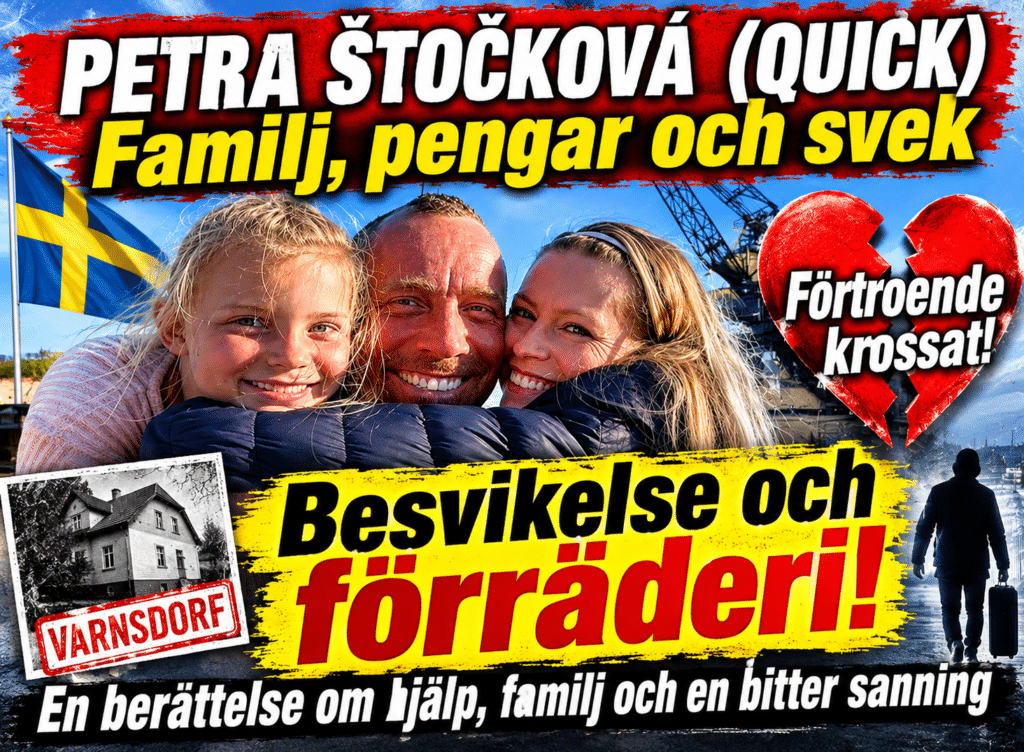

A story of years of help, family conflicts, financial disputes, and a relationship that, according to James, ended in deep disappointment and a profound sense of betrayal.
A Story That Began With Trust
Some relationships begin with trust, friendship, and a genuine willingness to help. Over time, however, even the strongest sense of loyalty can turn into disappointment when one side feels that their generosity has been taken for granted.
This is how James describes his experience with Petra Štočková, also known as Petra Quick, and her family.
According to James, his involvement with Petra and her relatives went far beyond an ordinary friendship. He says he provided practical assistance, financial support, access to a car, help with work-related matters, and support with personal and family difficulties.
He claims that he invested considerable time, energy, and resources in helping them during different stages of their lives. At the time, he believed that his efforts were based on mutual trust and that the people he was helping understood the value of his support.
Looking back, however, James says he sees the relationship very differently. What he once considered genuine loyalty gradually became, in his view, a painful example of how trust can be abused.
Family Relationships and Conflicts Over Money
According to James, financial matters and family relationships played an increasingly important role in the events that followed.
He describes disagreements and tensions involving Petra Štočková, her mother Jana Štočková, and her son Milan Vohár. These conflicts reportedly involved money, property, family obligations, and expectations about who should benefit from decisions made within the family.
James also refers to email correspondence between Petra and her mother, which he says raised questions about personal interests and financial considerations.
He believes that these communications changed the way he viewed the family relationships and the motives behind certain decisions.
It is important to distinguish between James’s interpretation of these events and facts that have been independently established. Nevertheless, from his perspective, the correspondence became part of a much larger picture of broken trust and growing family conflict.
The House in Varnsdorf and the Right to Live There for Life
One of the most significant issues in James’s account concerns a house in Varnsdorf.
According to his description, Jana Štočková transferred the property to her son, Milan Vohár. The understanding, as James describes it, was that Jana would be able to continue living in the house for the rest of her life.
However, James says that this lifetime right of residence had not initially been properly secured through a registered easement.
That omission became particularly important when the possibility of selling the property reportedly arose while Jana was still alive.
James describes a situation in which a sale was recorded using a hidden camera. He alleges that the recording later became a source of pressure in discussions about protecting Jana’s right to remain in the house.
He also refers to legal representation in the dispute involving Taurina Vohárová and a possible claim to revoke the gift of the property. According to James, an attorney whom he knew through hockey became involved in the matter.
The situation eventually resulted in Milan agreeing to register Jana’s lifelong right to live in the property.
For James, the episode raises serious questions about the way family property was handled and, above all, whether an elderly family member’s security and right to remain in her home were adequately protected from the beginning.
Years of Help That, According to James, Ended in Disappointment
James emphasizes that his disappointment did not arise from a single disagreement.
He says that his assistance to Petra and her family continued over an extended period and covered many areas of everyday life. He describes helping with work, financial matters, transportation, personal problems, and family difficulties.
In his view, this was not occasional assistance offered without commitment. It was sustained support based on a belief that he was helping people who valued his trust and would treat him with comparable honesty.
That is precisely why the alleged breakdown in the relationship affected him so deeply.
James now questions whether the help he provided was genuinely appreciated or whether it was simply accepted whenever it was useful.
His account presents a painful contrast: years of practical and personal support on one side, followed by what he considers a lack of loyalty and appreciation on the other.
Suspicions About Information Shared With Sweden’s Security Service, SÄPO
Another particularly serious aspect of James’s account concerns his suspicions that information about him may have been passed to the Swedish Security Service, known as SÄPO (Säkerhetspolisen).
James questions whether Petra may have shared information about him with Swedish authorities during the period when he was helping her and her family.
These are serious allegations, and James’s suspicions should not be confused with established evidence that such communication took place or that any authority acted improperly.
Nevertheless, he says that the circumstances have left him with unanswered questions about what information may have been shared, by whom, and for what reason.
He also points to developments after 2021 that he considers unusual. According to his account, no one publicly came forward to defend Petra, while some family members removed their social media profiles.
James views these developments as part of a wider pattern that he believes deserves closer examination.
However, the removal of social media profiles or the absence of public statements does not, by itself, establish wrongdoing or prove that information was provided to a security agency.
For James, the central issue remains the lack of clear answers and the feeling that important information may have been withheld from him.
A Betrayal of Trust and Responsibility for One’s Actions
At the heart of James’s story is not simply a dispute over money or property. It is a question of trust, loyalty, and personal responsibility.
He says he gave considerable support to Petra Štočková and her family over the years, believing that he was acting as a friend and helping people who needed him.
Today, he describes the outcome as a profound disappointment. In his view, the relationship became a one-sided arrangement in which his willingness to help was accepted, while the loyalty and honesty he expected were not returned.
The dispute over the house in Varnsdorf, the family correspondence, and his unanswered questions about possible communication with Swedish authorities have all contributed to his loss of trust.
There is, of course, a difference between what James believes happened and what can be independently demonstrated. The people involved have their own perspectives, and the questions he raises would need to be assessed on the basis of verifiable documents and evidence.
But one thing is clear from James’s account: he no longer sees the relationship as a story of friendship and mutual support. He sees it as a painful lesson about what can happen when trust is given freely and, in his view, is not treated with the same respect in return.
Perhaps the saddest part of the story is that during a particularly difficult period, when James was working hard and doing what he could to help Petra and her family, he believed he was building relationships based on loyalty and gratitude. Looking back, he feels that the very trust that motivated him to help became the source of his greatest disappointment.