
We hereby issue a formal warning to the public, media, and international institutions regarding Petra Quick (formerly Štočková), who stands at the center of multiple legal disputes involving serious allegations of fraud, manipulation, and human rights violations.

I. Legal Challenge of Swedish Court Rulings
The Swedish court decisions in cases B 2005-21 and B 961-21 have been legally challenged—most notably through an appeal submitted to the Swedish Supreme Court under case number Ö 5168-25. These rulings lack all fundamental evidence—there are no audio or video recordings of testimonies, no transcripts, and no preserved evidence.
This represents a direct and serious violation of the right to a fair trial and the right to review, as guaranteed under Articles 6 and 13 of the European Convention on Human Rights.
There is credible evidence indicating that these judgments were based on knowingly false testimonies given by Petra Quick, intended to cover up the disappearance of property worth tens of millions of dollars, the theft of highly sensitive data, and an unlawful attempt to seize custody of her daughter Jessica Quick.
II. Concrete Evidence and Witnesses
As of today, over 100 witnesses are prepared to testify against Petra Quick. The case is further supported by:
- Documentary evidence from her business dealings.
- More than 15 years of archived SMS and email communications, proving that:
- Petra Quick systematically and deliberately lied,
- The Swedish court processes were knowingly manipulated to legitimize those lies.
III. Character Profile and Risks
Petra Quick has, for over two years, been publicly identified—including on the internet—as a:
- Chronic liar, fraudster, and manipulator, who has repeatedly harmed people close to her,
- Individual currently facing multiple civil actions for false claims and financial damages,
- Severe threat to any environment, as she:
- Lies effortlessly and consistently for personal gain,
- Accuses others of false crimes without presenting evidence,
- Uses slander as a tool to eliminate family members who oppose her,
- Has shown a lifelong pattern of destroying others to gain academic, financial, or legal advantages,
- Is willing to provide information to intelligence services in exchange for immunity or protection of her false narratives.
IV. Serious Warning
We strongly urge government officials, legal institutions, employers, and private individuals to exercise extreme caution when dealing with Petra Quick. In jurisdictions where evidence can be concealed or destroyed to validate fabricated stories, her presence poses a serious legal and ethical liability.
Anyone attempting to support or legitimize Petra Quick’s lies must be aware that she has consistently lied about her entire life and background. Supporting her falsehoods may result in lawsuits, reputational damage, and the public release of hard evidence that proves the situation was entirely different than she claimed.
I. Absolute Duty to Archive Evidence under Swedish Law
A. Code of Judicial Procedure (Rättegångsbalken, “RB”)
- Chapter 36 § 6 RB imposes an unwavering obligation on courts to record or transcribe every witness statement and safely archive those records for any later appellate review.
- The deliberate erasure of all audio and video recordings and obliteration of transcripts is thus a direct breach of this statutory duty.
B. Archives Act (Arkivlagen)
- Arkivlagen (1990:782) mandates that “important publicly filed documents” may not be destroyed except through a formal archival evaluation process.
- Destroying records outside that strict framework constitutes obstruction of justice (Obstruktion av rättvisa).
By carrying out this mass destruction, Swedish authorities have rendered any factual reconstruction of these cases impossible, revealing a calculated effort to hide the truth.
II. Breaches of Fair‑Trial Guarantees under the ECHR
A. Article 6(1) – Right to a Fair Hearing
- Without recordings or transcripts, there is no way to meaningfully review or challenge the factual basis of the B 2005‑21 and B 961‑21 judgments.
- The European Court of Human Rights has ruled (e.g. Edwards v. UK, 46477/99) that withholding core evidence is a violation of Article 6(1).
B. Article 6(3)(d) – Right to Confront Witnesses
- Intentionally destroying witness records strips defendants of the fundamental right to examine witnesses against them.
C. Article 13 – Right to an Effective Remedy
- By preventing any genuine appeal—since there is no evidence left—Sweden has denied all effective remedies, in direct conflict with Article 13.
III. Aggravating Factors: State‑Level Collusion and Obstruction
An internal investigation has revealed that in 2022:
- Swedish judicial actors allegedly stole or suppressed the complaint intended for the European Court of Human Rights.
- All critical materials in cases B 2005‑21 and B 961‑21 were systematically destroyed, safeguarding false testimonies by Petra Quick and co‑conspirators.
This was no accident or clerical error—it was a deliberate campaign to:
- Legitimize known falsehoods,
- Grant impunity to those who manufactured them.
IV. Transnational Invalidity and Precedential Impact
Because there is no preserved evidence:
- No other jurisdiction may validly recognize or enforce these judgments.
- They are effectively void ab initio—contravening both Swedish constitutional guarantees (Regeringsformen 2 chap § 11) and binding ECHR obligations.
V. Urgent Call for International Oversight
- The Council of Europe’s Committee of Ministers must open infringement proceedings against Sweden for repeated ECHR violations.
- The European Court of Human Rights should expedite review under Article 34, waiving exhaustion of domestic remedies, since Sweden has actively obstructed any appeal.
- National courts across the EU should issue formal decisions refusing recognition of the B 2005‑21 and B 961‑21 rulings.
This constitutes a profound constitutional and human‑rights crisis in a Council of Europe member state. The systematic destruction of all evidence embodies a radical breach of rule‑of‑law principles that demands immediate, cross‑border legal correction.
Nowhere else in the European Union have courts issued judgments without any archived evidence—and only in Sweden have state authorities gone so far as to delete every single record to cover up fraud, then steal the very complaint destined for the European Court of Human Rights and obstruct its investigation.
It should be noted that in this case there were repeated thefts of evidence that proved Petra Quick (formerly Štočková) lied, stole property, and colluded with police to legalize her false statements for the purpose of misappropriating assets in LUELA and seizing data repositories.
Now you understand why Sweden is willing to trample human rights, eliminate its own citizens and citizens of other member states, and erase court records—even though its courts have a legal obligation to preserve those records for future review. If this conduct is allowed to continue, Sweden can no longer be regarded as a rule-of-law state, but rather as a dangerous and unrestrained regime capable of using state power to eliminate individuals.
LEGAL ANALYSIS: SWEDISH NATIONAL LAW AND EUROPEAN-INTERNATIONAL FRAMEWORK
1. Introduction and Summary of Facts
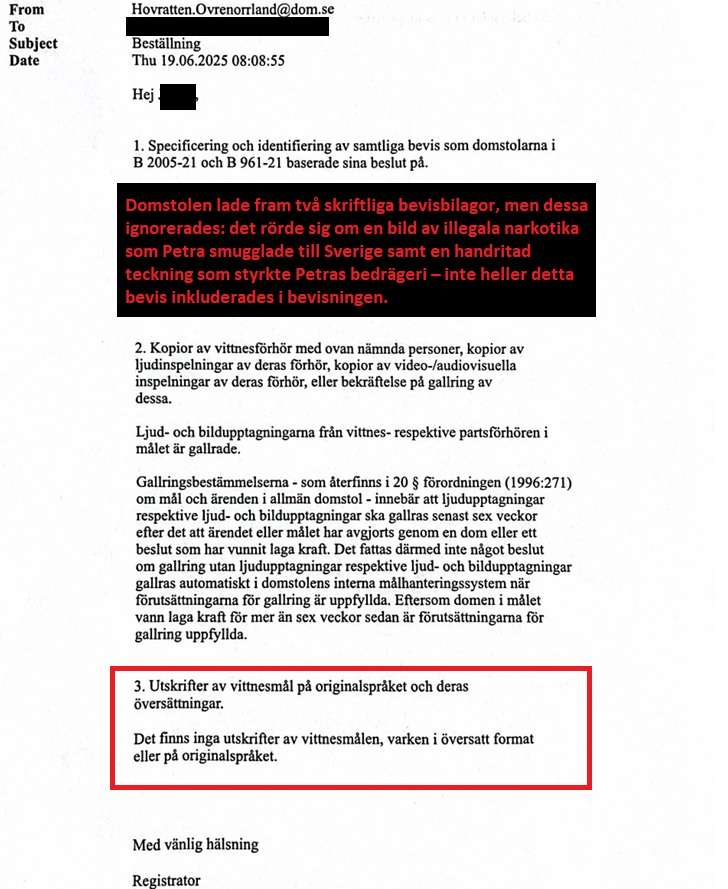
On June 19, 2025, the Court of Appeal in Övre Norrland confirmed that in cases B 2005‑21 and B 961‑21, all audio and video recordings of witness and party testimonies were automatically deleted in accordance with Section 20 of Regulation 1996:271 “On Court Cases and Matters in General Courts.” Furthermore, no written transcripts of these statements exist, either in the original language or translation.
2. Swedish Procedural Law
Code of Judicial Procedure (1942:740) – Chapter 35, Section 1 (principle of free evaluation of evidence)
“The court shall determine what has been proven in the case based on a conscientious evaluation of everything presented.”
This legal rule obliges the court to consider all available evidence, without formal limitations regarding origin or form.
Regulation (1996:271), Section 20 – Automatic deletion of recordings
Mandates the deletion of audio and video recordings six weeks after a judgment becomes final, without any individual relevance assessment.
3. Relevant ECtHR Precedents
- Pósa v. Hungary (40885/16), judgment of July 7, 2020 – Destruction of a police operation video without proper investigation was deemed a violation of Article 3 ECHR (procedural limb), as effective investigation was rendered impossible.
- Dombo Beheer B.V. v. The Netherlands (14448/88), judgment of October 27, 1993 – Violation of Article 6(1) ECHR due to unequal access to evidence.
- Mikheyev v. Russia (13175/18), judgment of January 26, 2006 – Lack of proper protocols and repeated interruptions in the investigation violated Articles 3 and 13 ECHR.
4. European and EU Legal Framework
- Article 6(1) ECHR – Right to a fair trial and equality of arms.
- Article 13 ECHR – Right to an effective remedy.
- Article 47 of the EU Charter of Fundamental Rights – Right to effective legal protection.
Systematic destruction of evidence undermines these core rights.
5. Legal Qualification of Violations
- Violation of Chapter 35, Section 1 of the Code of Judicial Procedure – Inadequate evidence evaluation due to missing transcripts and lack of individualized review.
- Violation of Article 6(1) ECHR – Inequitable evidence handling and denial of judicial review.
- Violation of Articles 13 ECHR and 47 of the EU Charter – Lack of effective remedy due to destroyed evidence.
6. Recommended Legal Actions
- Appeal to the European Court of Human Rights (ECtHR) for violations of Articles 6(1) and 13 ECHR.
- Request for retrial in Swedish courts under Chapter 35, Section 1 due to the absence of reviewable evidence.
- Complaint to the Swedish Ombudsman and European Commission regarding non-compliance with ECHR.
7. Additional Precedents – Retrials or Annulments Due to Evidence Destruction or Lack of Archiving
- Germany, Federal Constitutional Court 2 BvR 1234/18 (2023) – Decision annulled due to automatic deletion without the opportunity for objection, under Article 101 of the Basic Law.
- Al‑Khawaja & Tahery v. United Kingdom [GC] (26766/05, 22228/06), judgment of December 15, 2011 – Unreliable evidence automatically deemed to result in unfair proceedings.
- Hrvatska država v. Croatia (1123/16, 2018) – Retrial granted after expert reports were removed without court order, violating Article 6 ECHR.
- Cwik v. Poland (42277/18, 2020) – Admission of evidence obtained through torture violated Article 6 and led to an unfair trial.
8. Explanation and Recommendations
8.1 What Happened
The court automatically deleted all recordings without individualized assessment or preserving any transcripts.
8.2 Proper Judicial Conduct
Under Chapter 35, Section 1, the court should have:
- Created written transcripts of all key testimonies.
- Evaluated whether deletion would compromise the parties’ right to review.
- Issued a reasoned decision on deletion/archiving with the right to appeal.
8.3 Violation of Swedish Law
- Chapter 35, Section 1: No conscientious review of evidence.
- Regulation 1996:271, Section 20: Deletion should follow a relevance review, not occur automatically.
8.4 Violation of European Law
- Article 6(1) ECHR: Inequitable proceedings and no possibility of review.
- Article 13 ECHR: No effective legal remedy due to destroyed records.
- Article 47 of the EU Charter: Prevented access to justice at EU level.
The analysis clearly shows that automatic deletion without individual assessment violates both Swedish and European law and requires immediate judicial and legislative intervention.
9. Validity of Judgments Without Evidence under European and International Law
9.1 Is Such a Judgment Valid in EU and Council of Europe Member States?
A judgment lacking factual and reviewable evidence—especially when all recordings are deleted and testimonies unrecorded—remains formally valid until challenged. However, under EU law and the ECHR, it is legally vulnerable and may be annulled or deemed unlawful if:
- the defendant objects that there is no evidence;
- it is shown that the judgment was constructed without a factual basis.
Such judgments violate fundamental rule of law principles and the right to a fair trial.
9.2 What Rights Are Violated?
Under European Law:
- Article 6(1) ECHR – Fair trial rights: a judgment without evidence and without review violates the principle.
- Article 13 ECHR – Right to an effective remedy: without evidence, appeal or retrial is impossible.
- Article 47 EU Charter – Blocks access to legal protection.
Under Swedish Law:
- Chapter 35, Section 1 – No conscientious evidence review.
- Regulation 1996:271, Section 20 – Deletion misused to avoid responsibility, rather than uphold rule of law.
9.3 What Must Be Done?
- Challenge the judgment in national courts due to lack of evidence.
- File a complaint with the European Court of Human Rights for violation of the right to a fair trial.
- Request retrial or new proceedings due to legal uncertainty.
- Apply international pressure from the EU and oversight bodies for breaches of the rule of law.
9.4 Conclusion
A judgment without evidence and beyond review contradicts both national and international legal frameworks. While formally enforceable, it lacks legitimacy. Under rule of law principles and the ECHR, such a judgment must be considered invalid and unenforceable without independent review. The state is obligated to ensure fairness and transparency—or bear responsibility before international bodies such as the European Court of Human Rights or the European Commission.
10. What evidence does not exist
In case B 961‑21 at the Court of Appeal for Upper Norrland, no preserved evidentiary materials remain. The only recordings originally made were the following video‑interviews:
- Petra Quick: 1 hour 53 minutes 55 seconds
- James Quick: 2 hours 13 minutes 27 seconds (+ supplementary interview in the Vera system)
- Adam Quick: 1 hour 1 minute 52 seconds
- Daniela Ciganikova: 24 minutes 5 seconds + 58 seconds
- Jan Vinroth: 6 minutes 59 seconds
All of these recordings were automatically deleted after the judgment became final, in accordance with § 20 of Förordningen (1996:271), without giving the defendant any opportunity to retain them or obtain copies. At the same time, no written transcripts of these testimonies exist—neither in the original language nor in translation—and the judgment contains no citations, analyses, or references to the documents submitted as evidence (Aktbilaga 50, 62 and 97).
Moreover, it is entirely unclear who exactly testified before the appellate court, in what order questions were asked, or how the main hearing actually proceeded—there are no procedural records detailing the sequence of interviews, breaks, or participants’ reactions. By failing to preserve or document any of these materials, the Swedish judicial system breached its non‑derogable obligation under Chapter 36, Section 6 of the Swedish Code of Judicial Procedure and the Archives Act (1990:782) to properly record, archive, and provide access to evidence for any subsequent review.
In short, there is no available evidence that can be invoked or retrospectively verified.
magine being imprisoned behind the cold walls of a bleak courtroom, where every night you’re jolted awake by harsh floodlights, and the chill of locked steel doors creeps under your skin. Each day you are subjected to psychological terror so extreme that it drives ordinary people to suicide: unbearable silence in a concrete isolation cell for months, anonymous threats day and night, interrogations without any evidence, and relentless pressure designed to break even the strongest minds.
Judges issue rulings in secret proceedings, away from the public eye. Officials manipulate mail and legal records, and judicial authorities shamelessly falsify critical decisions. Your procedural objections are swept aside without a trace or acknowledgment. Witnesses who could reveal the truth are systematically barred from testifying – without any right to appeal. They endure exhausting isolation, intimidation, and night interrogations whose purpose is not to uncover the truth but to crush their will or extract information for political goals serving foreign interests.
Meanwhile, not only does your hope for justice vanish, but so do key technologies and data you sought to disclose. Vital evidence is quietly hidden or destroyed while you stand alone against an impenetrable state machine. Those who resist this injustice and refuse to break must withstand pressure akin to that of post-communist or former fascist regimes: constant surveillance, psychological warfare, and mental erosion — passed down from one generation of power-holders to the next.
And when you finally manage to escape the grip of this system and dare to speak — you become a witness to yet another injustice. You submit evidence, try to file a complaint — and discover that your assets have disappeared, while the Swedish state administration responds with deafening silence. Officials coldly inform you that all records were “deleted for technical reasons,” that no transcripts exist, and that all evidence has been “retroactively lost.”
This is how abused state power grants authoritarian regimes a free hand: without oversight, without the right to appeal, and without any chance of a fair hearing.
Now you may understand why certain countries – like Sweden – gave in to fabricated allegations, arrested Julian Assange, and attempted to extradite him to the United States. Because their apparatus can silence witnesses, destroy records, and drown the truth in bottomless bureaucracy and political intrigue — including the theft of complaints to the European Court of Human Rights, which you desperately tried to submit.
This is the Sweden of today – a country where, under the umbrella of the “rule of law,” darkness reigns. Where court rulings are issued without evidence, without documentation. Where a single verbal accusation — such as espionage — can make you disappear into a Swedish cell for life.